
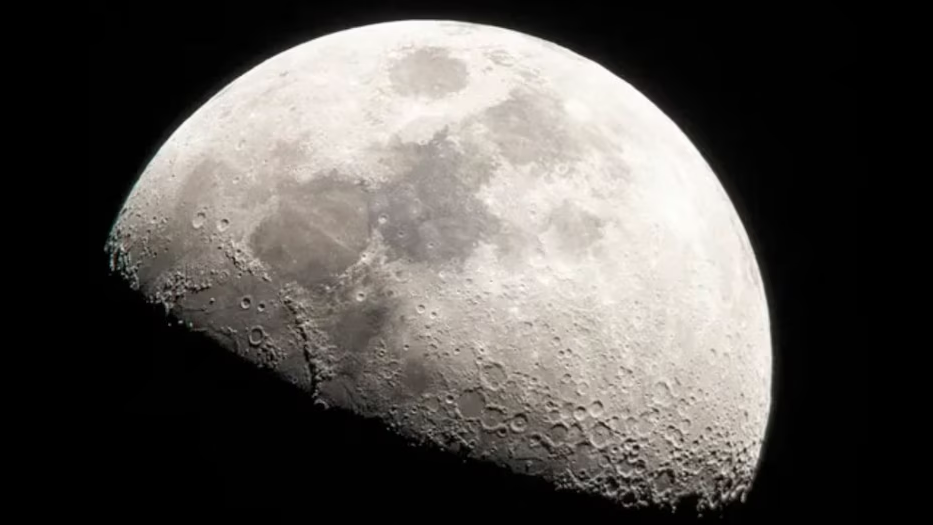
For years, astronomers have puzzled over why the Moon’s thin dust halo isn’t evenly spread — it’s noticeably thicker on the side facing the Sun. A new study now points to the culprit: the Moon’s wild temperature fluctuations between day and night.
Researchers used advanced computer simulations to explore how micrometeoroids — tiny space rocks that constantly bombard the lunar surface — behave under different thermal conditions. The models revealed that when these particles strike the Moon’s sunlit, heated soil, they blast 6–8% more dust into the surrounding space compared to impacts on the frigid night time surface. This difference causes the dust cloud to tilt toward the illuminated side, creating an uneven, heat-skewed halo.
Sébastien Verkercke, a postdoctoral researcher at France’s Centre National D’Études Spatiales (CNES) and lead author of the study, explained that each dust grain was “individually tracked to see how it spread through space.” These midday collisions send extra material drifting above the lunar surface — subtly reshaping the Moon’s dusty environment.
NASA has long warned that lunar dust poses serious challenges: it can cling to machinery, wear down spacesuits, and even harm astronauts’ lungs if inhaled. Understanding how this dust moves and accumulates is therefore vital for upcoming lunar missions.
The same mechanism may apply elsewhere too. On Mercury, where daytime temperatures soar even higher, scientists expect this asymmetry to be even more pronounced. The European Space Agency’s BepiColombo mission could soon put that theory to the test.
Micrometeoroid impacts are the quiet architects of this phenomenon. Each minuscule strike chips lunar rock into fine particles, launching them skyward and sustaining a faint, persistent halo. NASA’s LADEE orbiter first confirmed this shimmering dust cloud in 2015, hovering hundreds of miles above the surface.
According to physicist Mihály Horányi of the University of Colorado Boulder, even “a single dust grain from a comet hitting the Moon can catapult thousands of smaller particles into the airless void.” Over countless impacts, these events maintain the haze — with sunlight giving it a noticeable tilt toward dawn.

Leave a comment
Your email address will not be published. Required fields are marked *