
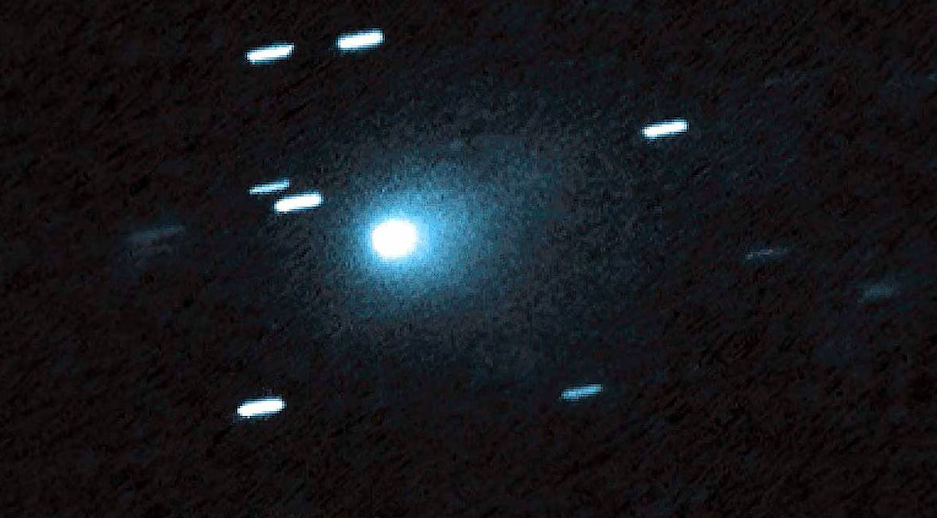
Space has become even more mysterious. Astronomers worldwide are deeply interested in 3I/ATLAS, a recently discovered interstellar comet that is performing something never seen before — it is changing color.
This comet was first detected by NASA's ATLAS telescope on July 1, 2025.
It is only the third known interstellar object to enter our solar system, after ‘Oumuamua and Comet Borisov. However, unlike those earlier visitors, this cosmic traveler has surprised scientists with a dazzling blue glow that becomes brighter as it moves closer to the Sun.
Initially, 3I/ATLAS appeared as a dim, icy body moving silently through space.
But as it approached the Sun, it suddenly burst into a deep sapphire light, with astronomers describing it as looking “bluer than the Sun itself.” After vanishing behind the Sun for several months, it has reappeared, glowing bright blue once more, rekindling global curiosity.
“3I/ATLAS isn’t just another piece of space debris — it’s an interstellar message, and each color change might offer a clue about where it came from,” said a NASA scientist involved in the ongoing study.
NASA has confirmed that the comet does not pose a threat to Earth.
On December 19, 2025, it will come closest to our planet, passing safely at a distance of about 167 million miles (270 million km).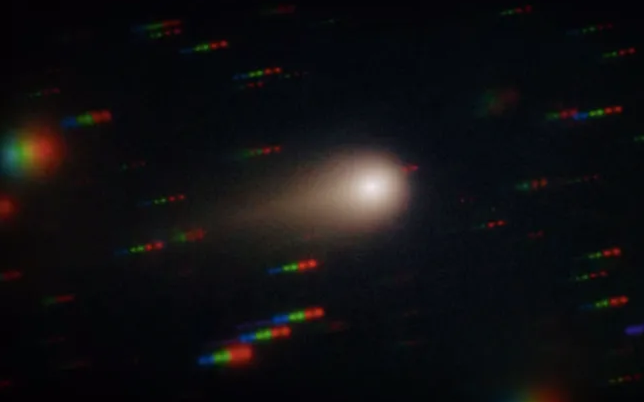
Still, not everyone thinks it’s a natural comet.
Harvard astrophysicist Avi Loeb, known for his bold theories about interstellar strange objects, has suggested there’s up to a 40% chance that 3I/ATLAS might be artificial, possibly even a probe made by an alien civilization.
Loeb’s argument is based on the object’s unusual acceleration — movement that doesn’t match what is expected from a regular ice-and-dust comet.
“If we don’t observe a significant gas cloud or dust trail around 3I/ATLAS in December,” Loeb explained, “it could suggest some kind of propulsion system.”
Although this idea sounds like something from science fiction, Loeb’s past theories about ‘Oumuamua have already led to serious scientific discussion.
And with 3I/ATLAS now showing strange light changes and color shifts, interest from both scientists and the public is at an all-time high.
Telescopes around the world are now watching the interstellar visitor closely, hoping the December flyby will reveal more about its surface, makeup, and any tail activity.
Whether it turns out to be a natural object from a distant star system or something far more unusual, 3I/ATLAS has already become one of the most intriguing space discoveries of the decade.

Leave a comment
Your email address will not be published. Required fields are marked *