NASA Interstellar Comet 3I/ATLAS Sparks Unusual Wave of Global Planetary Defense Drills
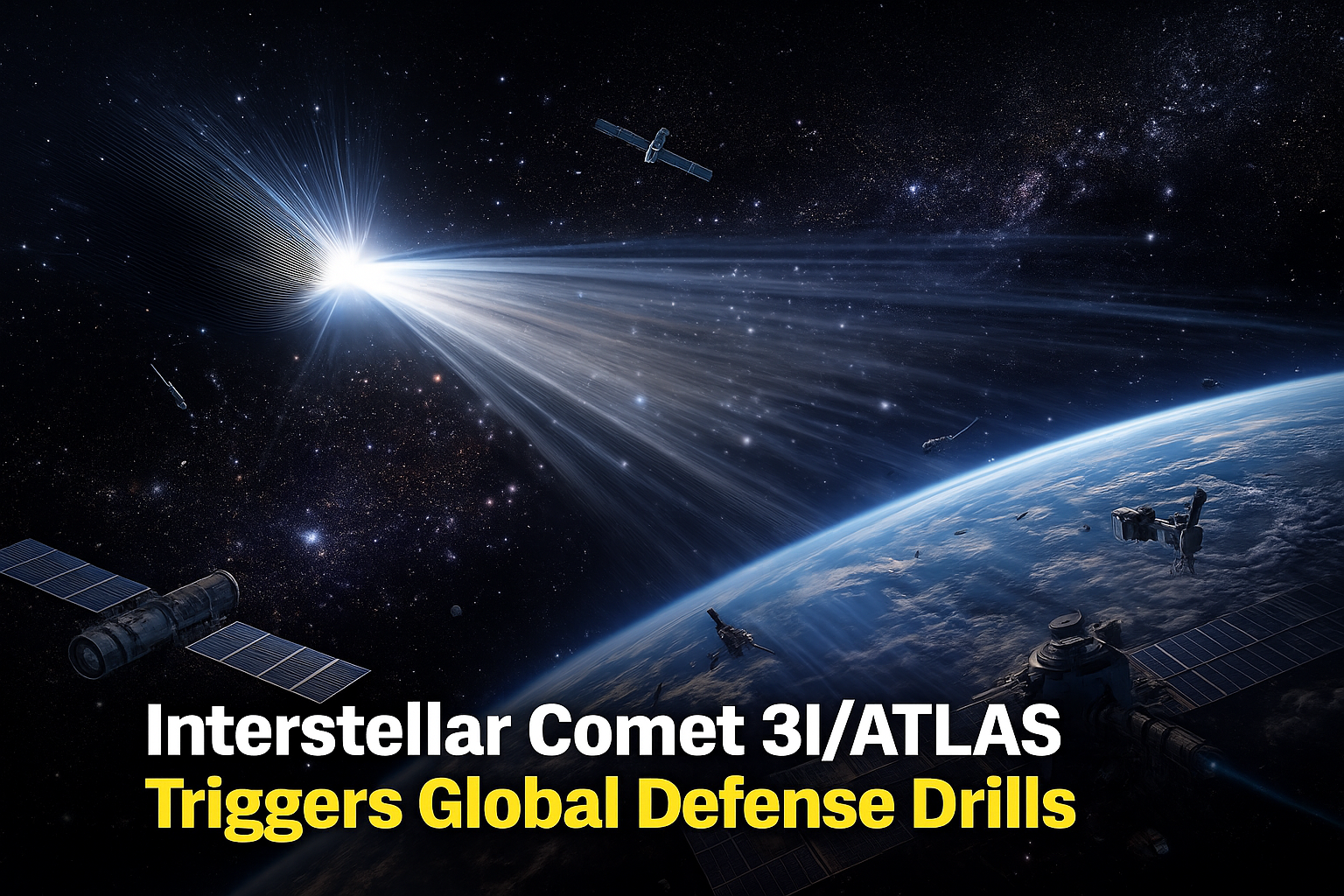
A series of unusual planetary defense exercises has quietly swept across multiple nations, raising serious questions among astronomers and defense observers. Authorities maintain that these simulations are routine, yet the sudden timing and worldwide coordination suggest a deeper underlying concern. At the center of this rising alert is 3I/ATLAS, an interstellar visitor exhibiting behavior that defies conventional astrophysics.
The chain of events began when the European Space Agency (ESA) activated its entire planetary defense protocol for an intensive three-day drill. The program involved mission control teams, rapid-impact modeling units, and synchronized ground-based sensor networks — a level of readiness typically reserved for high-risk threats. Soon after, Japan launched its own accelerated asteroid-impact simulation that involved military, civilian, and commercial satellite operators.
Within 48 hours, the U.S. Space Force also executed a high-orbit tracking drill originally scheduled for late 2026 but mysteriously pushed months ahead, according to The Express.
Countries that usually keep such operations quiet — including Australia, South Korea, and Brazil — unexpectedly joined the wave of simulations. Internal documents show that many of these drills relied on global data-sharing networks designed to analyze “high-velocity, non-gravitationally accelerated objects,” a term that experts widely associate with the puzzling behavior of 3I/ATLAS.

Why Are Nations Suddenly Coordinating These Large-Scale Drills?
The urgency is believed to be driven by the unpredictable and strange behavior of 3I/ATLAS. Observatories have reported anti-tail jets pointing toward the Sun, erratic brightening and dimming cycles, and persistent acceleration that does not follow known natural or gravitational forces. Its rotational variations and trajectory shifts have further deepened scientific concern.
A prominent theory proposed by astrophysicist Avi Loeb suggests that the “sunward anti-tail” of 3I/ATLAS might not be a gas stream at all. Instead, it could represent a cluster of compact objects traveling together. His data indicates that if such a swarm exists, the smaller bodies may orbit closer to the Sun while maintaining an offset of tens of thousands of kilometers relative to the primary object.
This hypothesis aligns with several observations recorded since July, according to The Express.
Why Is 3I/ATLAS So Hard to Track?
If Loeb’s swarm model is correct, Earth’s defense systems are not dealing with a single interstellar body but potentially multiple independent objects, each with its own mass, brightness, and orbital path.
This makes tracking significantly more complex.
- Defense analysts warn that such a scenario demands:
- More powerful deep-space sensor networks
- Expanded satellite constellations
- Faster reaction systems
- Higher-resolution infrared surveillance
- The uncertainty surrounding 3I/ATLAS’s movement has pushed global agencies to reassess their monitoring capabilities.
How Governments Are Using the Event to Accelerate Defense Technology?
According to sources familiar with ongoing discussions, the mystery surrounding 3I/ATLAS has created a rare moment where governments can rapidly advance controversial space-defense technologies. Tools that typically trigger international debates — such as classified infrared arrays and next-generation reconnaissance satellites — are being approved without resistance.
The European Space Agency’s $25.7-billion defense expansion cleared approvals at record speed. In the U.S., procurement data shows unusually urgent contracts for upgraded surveillance and tracking systems.
The International Asteroid Warning Network (IAWN) has also introduced new protocols allowing temporary use of classified intelligence sensors to studies “non-standard hyperbolic bodies.”
Meanwhile, 3I/ATLAS continues to confound scientists. It shows inconsistent acceleration patterns, unexpected brightness changes, and rotational anomalies that do not align with the behavior of any known natural object.
As December 19 approaches — a key observation window — governments appear to be using the situation to accelerate planetary defense developments by years.

Leave a comment
Your email address will not be published. Required fields are marked *